Showing posts with label chinese. Show all posts

Friday, August 30, 2013

My friend made Malatang from scratch

In my desperation to recapture the taste of China that I so miss since I left last July, my friends tried to recreate Malatang (麻辣烫) at home by following a simple recipe from the internet, which unfortunately I did not jot down. So I can't tell you the precise ingredients and measurements of what actually went into the stock, but it turned out to be very spicy and delicious, even though the taste wasn't quite at the level of the malatang I used to have on the streets of Xiamen.

First we went to Food Hall at Plaza Indonesia for the ingredients. We bought lots of meatballs and seafood meatballs, tofu, mushrooms, and vegetables. For the broth itself, we bought pork and chicken bones, garlic, star anise, ginger, powder chili, sichuan peppercorns (numbing goodness). And that's about it.

We did not put any MSG into the stock, because I HATE MSG!!!!!!

We made the stock and then added the other stuff in. I liked it. Next time, I would add more garlic and ginger to the mix and try to get some chili pepper with sesame oil in it. Maybe that would do the trick a bit.

Saturday, August 24, 2013

In China I ate: Cong You Bing (葱油饼)

Ok, Cong You Bing (葱油饼)actually means onion bread, which sounds kinda weird, because the bread isn't made of onions. Actually, Cong You Bing is a round flat dough that is fried with a filling of scallions. There are other versions of this fried dough. The halal restaurant near my school in Jimei would also serve Niu Rou Bing (牛肉饼)- aka dough with beef filling and Huluobo bing (胡萝卜) - aka dough with carrot filling.

My preference was the beef, but the most popular version that one can find everywhere I guess is the scallion. This would be my snack on the way home from the flea market nearby when I didn't know what else to eat. I could always go to the Qingzhen (清圳)- halal - restaurant and order this delicious goody.

Wednesday, August 21, 2013

In China I ate: kaorou (烤肉)

Kaorou is basically barbecue, but in China, a bunch of spices are used like cumin, pepper, sesame seeds, etc. The vendors would usually fry all the ingredients we've chosen and then put them on the grill.

My friend said that having too much barbecue can be bad for you because, well, we all know about charcoal and what happens to your lungs and stomach. 

Anyway, aside from the unhealthy part of Kaorou, I dig it very much. It's cheap, good, and filling.


Sunday, August 18, 2013

In Xiamen, China, I ate at Kaliwang (咖哩王) restaurant

There is a restaurant near my school in Jimei called Kaliwang. It means curry king. I liked going there because the fried chicken tastes similar to Indonesian fried chicken, which satisfied my home food cravings.


The owners of the restaurant are total hippies. They play loud rock music in the evenings, sit around and drink beer all night, smoke a lot, make fun of passersby, and so on. They also have a white cat named Obama who likes to sleep on the tables while customers eat. 


Obama lounging around on the table next to ours.

The owner of this restaurant (who is also the chef) is a hippy.

Thursday, August 15, 2013

In Xiamen, China, I ate at Zhen Xiang Dao He Xiang Fan (真香道荷香饭) restaurant

When I lived in Jimei district, Xiamen city, I would often go to Zhen Xiang Dao He Xiang Fan (真香道荷香饭) restaurant. I guess that would translate to "really fragrant, fragrant lotus" meals....

I've always wondered which region of China did the type of cooking of this restaurant come from. Well, I looked all over the internet and only found one description, the restaurant's own ad, which says that it serves typical Fujian cooking where rice and ingredients are steamed all together on top of lotus leaves. The restaurant also specializes in hot plates. 

I don't know what the locals think of this place. I never bothered to ask, but I personally liked it.


Wednesday, August 7, 2013

In China I ate: Jimihua (鸡米花)

Yes, this particular post is dedicated to Jimihua (鸡米花), or better known throughout the English-speaking world as popcorn chicken. I know they aren't fancy and they aren't even that special, but you see, I was on a scholarship in Jimei, Xiamen, and the end of the first semester came around.

In China, the lunar new year aka Chinese new year aka Chun Jie (春节) aka spring festival in either mid-January or mid-February, is a super long one-month event where everyone, especially students, get a month's worth of vacation. It is THE holiday, and everyone goes on a pilgrimage from the place where they work or go to school to travel back to their hometowns.

I was one of those expats who got to experience the utter loneliness of Chun Jie, as I didn't have a hometown to go back to, and Jimei was pretty much deserted. Imagine a ghost town where hardly any shops and restaurants are open, where there are no night markets, street stalls, etc. That was what I experienced for a month.

As someone who was on a scholarship, I fully relied on my monthly stipend. But as it was Chun Jie and everyone disappeared from town, my donors kind of forgot to send me and my friends our February allowance. We were left with hardly any money. I was lucky I still had 500RMB on me, but my other friends went with a lot less. 

This put me in an awful conundrum. I needed to eat, but also needed to spend the least amount of money as possible in order to survive. So what I did was cook my own soups during the day, and then at night go to one of those Chinese wannabe KFCs like CNHLS or DKG, and order Jimihua.


Why wannabe KFCs as my first-choice rescue restaurant, you ask? Because it was the only cheap source of protein that was available and OPEN during Chun Jie. Well, the McDonald's and actual KFC were open, but those are extremely expensive. A burger in the real chains could cost as much as 30RMB. That's just for the burger.

Meanwhile, a meal at a fake KFC (burger, drink, and fries/jimihua/chicken skewers/small chicken wrap) would be around 12 to 14RMB. Not bad for a starving student. A bag of jimihua would just cost 4RMB. It was a bargain.

So this post is dedicated to all the wannabe KFCs in Jimei, especially CNHLS, because they kept me alive for an entire month on Chun Jie.


Thank you!


Friday, August 2, 2013

In China, I ate: Youtiao (油条)

During my stay in China, I would usually go to class a half hour early just so that I could sit alone in the classroom and enjoy one youtiao (油条) and a cup of warm soy milk. That would be my daily breakfast.


I know that youtiao is prevalent all over the world now, but I was really happy to have had it in its country of origin. 

In Indonesia, where I come from, youtiao is called cakwe (taken from the hokkien name for youtiao = "yu charkway"). They are simply just fried salty dough strips. In my home country, we would usually have youtiao as a side dish for chicken porridge. Or sometimes we would eat them as a snack with a vinegar and chopped chili pepper sauce.

In China, people would also have youtiao as a side dish for porridge. But what I loved the most was that youtiao would be eaten for breakfast as an accompaniment for warm soy milk. 

Soy milk (especially warm one) is not readily available in street stalls in Indonesia because we are more accustomed to drinking cow's milk, and I don't see many cakwe vendors either. So I really enjoyed the Chinese way of eating youtiao, and that is one of the things I have missed the most from China.

Monday, July 29, 2013

In China, I ate: Minced Beef Noodles

I went to Zhongshan road in Xiamen once and was so hungry that I begged my friend to stop at the nearest restaurant and sit down for a meal.

Well we actually stopped right at a Chinese muslim restaurant (they are called qingzhen 清真 over there). If you see those characters, then the restaurant serves halal food. 

I ordered the first dish I saw on the menu, which was plain noodles with minced beef topped by a tomato sauce. I believe the dish is called Ban or Pan Lamian. I still to this day have no idea how to spell it in Chinese characters, as I've only had it once. 


This dish tastes very similar to spaghetti bolognese, except that the greens are from scallions, not from Italian herbs. Of course, the noodles aren't pasta, but well, when you are desperately hungry, anything will do.

So if you are in China and are craving spaghetti bolognese, go to a qingzhen restaurant. Order this cheaper alternative. Usually a large plate would be 11RMB. A smaller plate 9RMB. 


Sunday, July 28, 2013

In China I ate: duck porridge (鸭肉粥)

There is a restaurant near my school (Huaqiao University, Department of Chinese Language and Culture - 华侨大学华文学院) which specializes in duck meat and gruel. Yep, that's about it. 

If you are ever in the district of Jimei, Xiamen city, Fujian province, and want a light but delicious meal in the middle of the night, rather than going to McDonald's, try this much more satisfying alternative.


From my school, which is right in front of Longzhou pond (龙舟池), go to Shigu road (石鼓路) all the way until you reach McDonald's to your right.

My school location (look for I):


McDonald's location (look for A):

View Larger Map


Once you see McDonald's, cross the street and turn right on Jiyuan road... I have no idea what the hanzis for Jiyuan road are. Not too far from the intersection is the restaurant, called Bai Cheng Da Tong Yarou Zhou (百成大同 - 鸭肉粥). This restaurant only serves duck meat and other duck parts.... Well, actually it does have squid, but I tried it and that one wasn't good.

All the ingredients are laid out at the front counter and we choose whatever we want to put inside the porridge. Prices per item range from 1 RMB to 5 RMB. I usually put in one duck egg, one  tofu, duck breast, and have youtiao (salty fried dough strips) on the side. It never costs me more than 8.5 RMB. Cheap and satisfying, I always come here when I am craving something to eat. They are open from 7AM until 2AM, a rarity in Jimei.


The owners, a lady and her daughter, apparently used to live in Singapore. So, hello, neighbor! ^_^

Find more pictures of this place on the foursquare site.

Saturday, July 27, 2013

In China, I had an apple on Christmas

I probably should be posting this around Christmas, but oh well, I'm scared that I'm going to forget I ever received apples on Christmas. And some people might think "what's so special about apples anyway?" "Why apples on Christmas?"

Well, the Chinese don't traditionally celebrate Christmas, but it is now such a commercially successful Western event that the locals are creating their own Christmas traditions. 

So while I was studying in China, Christmas came around and I started receiving apples from my Chinese friends. They would include a "merry Christmas" card along with the apples. Another friend of mine even got a whole box of apples, which she couldn't finish.

I don't know if other countries have this tradition of giving out apples on Christmas.... I went to the Jimei church one day and asked the expats there whether or not their culture also has giving apples as a Christmas present. All of them said "no."

So then I asked my Chinese friend, why apples? Why not a banana? Or an orange? Or a Chinese fruit, like the pipa? 


He explained that the Chinese for apple is "pingguo" (苹果). The Chinese word for peaceful is "heping" (和平). 

As you can see, both words have the "ping" syllable. The "ping" in both words also use the second tone. And the Chinese character for pingguo (apple) has the character for "ping" in it. 

heping


My friend then continued to say that because Christmas has a lot to do with peace and calm, then the symbolic representation of that in China is an apple.

I don't quite know how true this is. Haven't really checked out websites on this topic, but I believed my friend. And in my opinion, it is a valid explanation for why in China apples are given as gifts on Christmas.

Friday, July 26, 2013

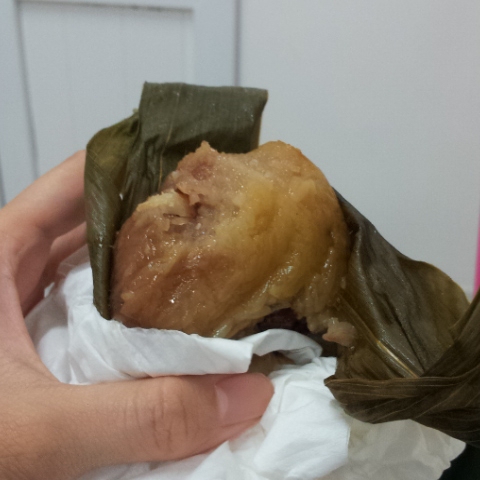
In China I ate: Zongzi (粽子)

The first week of June marks the dragonboat festival in China, or better known locally as "duanwu jie (端午节)."

During this festival, there are dragonboat races all over the country, but in terms of food, locals would eat Zongzi (粽子). They are pretty much glutinous rice triangles wrapped in bamboo leaves. My Chinese friend, Lily, told me that Zongzi fillings would usually consist of red bean paste, meats, or even nothing. 

The one that I got from Lily on duanwu jie was filled with red bean paste, and she told me to add honey to it to make it tastier.


There is a legend surrounding why locals eat Zongzi on the dragonboat festival.  A long time ago in China, a famous poet named Qu Yuan was so overcome with grief when the Qin took over Yingdu, the capital of Chu (where the poet came from), that he drowned himself in the Miluo river. 

It is said that locals threw sticky rice into the river so that the fish would eat the rice instead of Qu Yuan's body. 

And why is this story a part of the dragonboat festival? Well, because Qu Yuan's admirers paddled on dragonboats to scare away the fish and retrieve his body. The legend of the origin of the dragonboat races and the eating of zongzi on duanwu jie.

Thursday, July 25, 2013

In China I ate: Braised Beef Noodles (红烧牛肉面)

When a brand new mall opened in the district of Jimei where I went to school, my friends and I immediately went to visit and tried out one of the restaurants (everything was 50% off!). We eventually went to a place called Chengdu Snacks, which I guess would have food from Chengdu.

I ordered the braised beef noodles. On the menu it is called Hong Shao Niurou Mian (红烧牛肉面). I liked it, as I love spicy food. The broth was infused with dried red chili pepper, giving it a very blood-red color. Of course there was also beef and coriander leaves in the broth.

I went on a few websites and have read that this dish actually originated from Taiwan, but I am not sure. Whether it is from Chengdu or from Taiwan, it tasted darn good.


Tuesday, July 23, 2013

In China I ate: Tanghulu (糖葫芦)

One of my favorite wintertime snacks in China were Tanghulu (糖葫芦). They are basically candied fruits on bamboo skewers. These sweet treats are, as my Mandarin teacher tells it, a Beijing delicacy, and they are widely sold on the streets. 

The traditional fruit used for Tanghulu come from the Chinese Hawthorn tree.


I've tried the Chinese hawthorn. They taste a bit like apples. 

Nowadays Tanghulu is made up of all sorts of fruits, from strawberries, tomatoes, Chinese hawthorn fruit, oranges, and others.

My favorite is the strawberry, because I don't have to deal with getting rid of seeds, but the Chinese hawthorn fruit is a close second.

Some vendors would sell them wrapped in edible rice paper, which helps get rid of the sweetness of the caramelized sugar (if you don't like them too sweet, that is), but they can get pretty messy to eat. I personally like them without the wrapping.

In Beijing, a stick of strawberries would cost about 8 to 10 RMB. In Xiamen, a stick of five strawberries would range from 2 to 4 RMB. I was lucky I lived in Xiamen, so I was able to save money and not have to worry about what to eat the next morning.

Tanghulus aren't sold in the summer, as far as I know, as the sugar would melt right off.

If you are ever in China in the winter, do try one of these delightful sweet street snacks.


Monday, July 22, 2013

In China I ate: Shou Zhua Bing (手抓饼)

One of the first street foods I tried on my one-year stay in China was a really delicious pancake wrap called Shou Zhua Bing (手抓饼), which literally means "hand grasp cake," and is a popular snack from Taiwan. It's really an Asian shawarma, I guess.

The inside of the wrap would usually consist of meats and vegetables. Vendors would normally have bacon, ham, beef, sausage, chicken breast, chicken knuckles, and eggs.

For vegetables, the cook would add sliced cucumber and a bit of lettuce. We can also ask for dried seaweed sheets. 

For condiments, I would usually ask for mayonnaise (shala), black pepper sauce (heijiao), and chili pepper sauce (lajiao).

I unfortunately don't have many photos of Shou Zhua Bing, but here is a link which features this Taiwanese goody.

Sunday, July 21, 2013

In China I ate: Malatang (麻辣烫)

I had the good chance of going to school in China on a scholarship for a year. Was sent to study Mandarin Chinese in Jimei, which is a district in the city of Xiamen, located in the province of Fujian. As someone who loves to try different kinds of food, I was excited to be going to a country where food is a huge part of daily life. Who hasn't heard of succulent Peking duck or famous Sichuan chicken? In Indonesia, where I come from, Chinese food abound and it is as if they have become a part of the culture.

So imagine my disappointment when I first arrived there and tasted the local food, only to find that Fujian cuisine is somewhat bland and mild. Coming from a tropical country where an overwhelming amount of spices in food is the norm, it takes a bit of an adjustment to get used to Fujian food. Not that all Chinese food are bland, but it was my lack of knowledge of the local delicacies that kept me in the dark.


After a month on a very unhealthy diet of McDonalds and KFC, a friend took me to a restaurant near the school called Chongqing Malatang (重庆麻辣烫) which served Malatang, broth which can be filled with just about anything under the sun. Malatang is so tasty that I shouted "oh my good lord, there are spicy and tasty foods in Xiamen!"


Malatang is a really popular street food in the Northern part of China, but apparently it originated from Sichuan Province, except that in Sichuan it looks more like hot pot. Malatang, on the other hand, uses a mild spicy broth. At the restaurant near my school, we were able to choose if we wanted to add minced garlic, dried chili peppers, mala peppercorn (aka Sichuan peppercorn which is spicy and tongue-numbing at the same time), and salt.


Usually at Malatang stands there would be vegetables, meats, and tofus on skewers laid out on the food stand, and we are able to choose whichever ingredient we would want to be put in our soup. A vegetable item would usually cost 1 RMB, meats would range from 2 to 4 RMB. I loved putting in Chinese spinach (kangkung in Indonesian or kongxincai 空心菜 in Mandarin), tofu skin, quail eggs, coriander leaves, tomatoes, and lettuce. Malatang stands would also normally have a wide variety of noodles: dried ones, fresh ones, thin or thick ones. 


Afterwards, the chef would put all the ingredients we've chosen into a large pot with the broth and cook everything in it. Spicy and filling, this dish makes a perfect dinner on cold winter nights. 


I have heard of a malatang restaurant somewhere in Kelapa Gading, Jakarta, but I haven't had the chance to try it out.