What do I love to eat by the beach? Fresh guava with dried chili pepper powder and sugar. Sounds like a weird combination, but there is something special about sour, crunchy and watery mixed with sweet and spicy all at the same time. I love the confusing sensation in my mouth.
Showing posts with label snack. Show all posts
Tuesday, August 27, 2013
In Thailand I ate guava by the beach
What do I love to eat by the beach? Fresh guava with dried chili pepper powder and sugar. Sounds like a weird combination, but there is something special about sour, crunchy and watery mixed with sweet and spicy all at the same time. I love the confusing sensation in my mouth.
Location:
Phuket, Thailand
Saturday, August 24, 2013
In China I ate: Cong You Bing (葱油饼)
Ok, Cong You Bing (葱油饼)actually means onion bread, which sounds kinda weird, because the bread isn't made of onions. Actually, Cong You Bing is a round flat dough that is fried with a filling of scallions. There are other versions of this fried dough. The halal restaurant near my school in Jimei would also serve Niu Rou Bing (牛肉饼)- aka dough with beef filling and Huluobo bing (胡萝卜) - aka dough with carrot filling.
My preference was the beef, but the most popular version that one can find everywhere I guess is the scallion. This would be my snack on the way home from the flea market nearby when I didn't know what else to eat. I could always go to the Qingzhen (清圳)- halal - restaurant and order this delicious goody.
Labels:
beef,
bread,
carrot,
chinese,
cong you bing,
dough,
halal,
huluobo bing,
muslim,
niu rou bing,
qingzhen,
scallion,
snack,
street food
Friday, August 2, 2013
In China, I ate: Youtiao (油条)
During my stay in China, I would usually go to class a half hour early just so that I could sit alone in the classroom and enjoy one youtiao (油条) and a cup of warm soy milk. That would be my daily breakfast.
I know that youtiao is prevalent all over the world now, but I was really happy to have had it in its country of origin.
In Indonesia, where I come from, youtiao is called cakwe (taken from the hokkien name for youtiao = "yu charkway"). They are simply just fried salty dough strips. In my home country, we would usually have youtiao as a side dish for chicken porridge. Or sometimes we would eat them as a snack with a vinegar and chopped chili pepper sauce.
In China, people would also have youtiao as a side dish for porridge. But what I loved the most was that youtiao would be eaten for breakfast as an accompaniment for warm soy milk.
Soy milk (especially warm one) is not readily available in street stalls in Indonesia because we are more accustomed to drinking cow's milk, and I don't see many cakwe vendors either. So I really enjoyed the Chinese way of eating youtiao, and that is one of the things I have missed the most from China.
Labels:
bread,
breakfast,
cakwe,
chinese,
dough,
indonesia,
side dish,
snack,
soy milk,
youtiao,
yu charkway
Location:
Jimei, Xiamen, Fujian, China
Friday, July 26, 2013
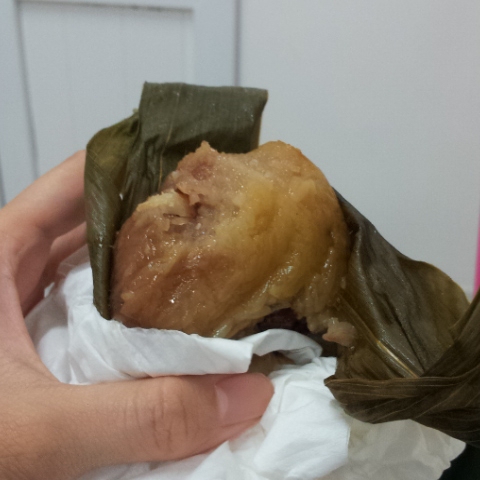
In China I ate: Zongzi (粽子)
The first week of June marks the dragonboat festival in China, or better known locally as "duanwu jie (端午节)."
During this festival, there are dragonboat races all over the country, but in terms of food, locals would eat Zongzi (粽子). They are pretty much glutinous rice triangles wrapped in bamboo leaves. My Chinese friend, Lily, told me that Zongzi fillings would usually consist of red bean paste, meats, or even nothing.
The one that I got from Lily on duanwu jie was filled with red bean paste, and she told me to add honey to it to make it tastier.
There is a legend surrounding why locals eat Zongzi on the dragonboat festival. A long time ago in China, a famous poet named Qu Yuan was so overcome with grief when the Qin took over Yingdu, the capital of Chu (where the poet came from), that he drowned himself in the Miluo river.
It is said that locals threw sticky rice into the river so that the fish would eat the rice instead of Qu Yuan's body.
And why is this story a part of the dragonboat festival? Well, because Qu Yuan's admirers paddled on dragonboats to scare away the fish and retrieve his body. The legend of the origin of the dragonboat races and the eating of zongzi on duanwu jie.
Location:
Jimei, Xiamen, Fujian, China
Tuesday, July 23, 2013
In China I ate: Tanghulu (糖葫芦)
One of my favorite wintertime snacks in China were Tanghulu (糖葫芦). They are basically candied fruits on bamboo skewers. These sweet treats are, as my Mandarin teacher tells it, a Beijing delicacy, and they are widely sold on the streets.
The traditional fruit used for Tanghulu come from the Chinese Hawthorn tree.
I've tried the Chinese hawthorn. They taste a bit like apples.
Nowadays Tanghulu is made up of all sorts of fruits, from strawberries, tomatoes, Chinese hawthorn fruit, oranges, and others.
My favorite is the strawberry, because I don't have to deal with getting rid of seeds, but the Chinese hawthorn fruit is a close second.
Some vendors would sell them wrapped in edible rice paper, which helps get rid of the sweetness of the caramelized sugar (if you don't like them too sweet, that is), but they can get pretty messy to eat. I personally like them without the wrapping.
In Beijing, a stick of strawberries would cost about 8 to 10 RMB. In Xiamen, a stick of five strawberries would range from 2 to 4 RMB. I was lucky I lived in Xiamen, so I was able to save money and not have to worry about what to eat the next morning.
Tanghulus aren't sold in the summer, as far as I know, as the sugar would melt right off.
If you are ever in China in the winter, do try one of these delightful sweet street snacks.
Monday, July 22, 2013
In China I ate: Shou Zhua Bing (手抓饼)
One of the first street foods I tried on my one-year stay in China was a really delicious pancake wrap called Shou Zhua Bing (手抓饼), which literally means "hand grasp cake," and is a popular snack from Taiwan. It's really an Asian shawarma, I guess.The inside of the wrap would usually consist of meats and vegetables. Vendors would normally have bacon, ham, beef, sausage, chicken breast, chicken knuckles, and eggs.
For vegetables, the cook would add sliced cucumber and a bit of lettuce. We can also ask for dried seaweed sheets.
For condiments, I would usually ask for mayonnaise (shala), black pepper sauce (heijiao), and chili pepper sauce (lajiao).
I unfortunately don't have many photos of Shou Zhua Bing, but here is a link which features this Taiwanese goody.
Subscribe to:
Posts (Atom)